
Introduction
Bangladesh has quietly become one of the biggest names in global denim production, and picking the right jeans manufacturer in Bangladesh can genuinely make or break a brand’s sourcing strategy. This guide gets into why the country dominates denim exports — and just as important, what actually separates a strong factory from a weak one.
You’ll learn the different manufacturer categories buyers typically encounter. You’ll also get the practical questions worth asking before signing a production agreement. By the end, you’ll understand where Bangladesh stands in the global denim market.
You’ll see how men’s denim production differs from ladies’ collections. And you’ll know what makes an established branded jeans manufacturer in Bangladesh worth the premium.
Why Bangladesh Dominates Global Denim Production
The numbers tell a clear story. Data from the US Office of Textiles and Apparel (OTEXA) and Eurostat shows Bangladesh held roughly a 26% share of US denim imports in 2025. That makes it the top single-country supplier to that market. In the EU, Bangladesh’s share climbed to nearly 30%. The country has held that top spot since overtaking China in 2017.
Combined denim shipments to the US and EU crossed $2.6 billion in a recent year. The Daily Star and Prothom Alo reported these figures, citing OTEXA and Eurostat data. This growth didn’t happen overnight, either. The industry traces back to 1984.
A small factory called NZN Fashion shipped just $12,000 worth of jeans to an Italian buyer that year. Four decades later, denim exports now regularly exceed $5 billion annually across all markets.
A few factors explain this rise:
- Affordable gas, water, and labor costs keep production competitive
- Heavy local investment in fabric mills — from about a dozen mills a decade ago to nearly 50 today
- Global buyers shifting orders away from China amid trade tensions
- A growing number of LEED-certified factories using laser, ozone, and waterless finishing
- Long-running international denim expos in Dhaka that connect global buyers with local producers
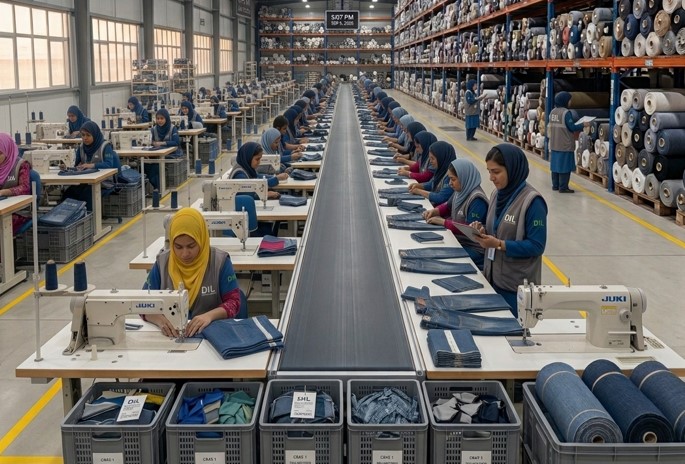
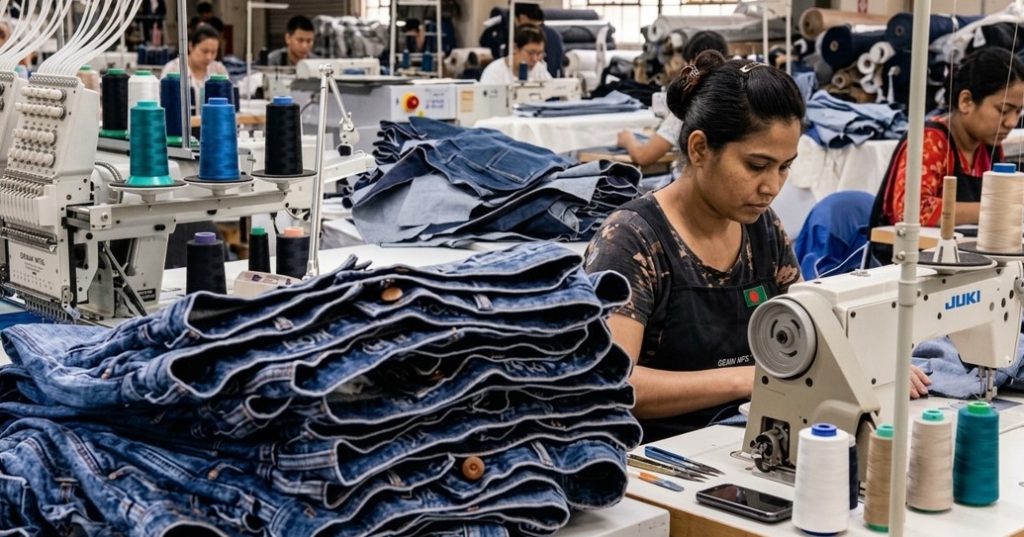
Major brands like Levi’s, H&M, PVH, and C&A now source heavily from the country. Bangladeshi mills can handle everything from spinning yarn to finishing under one roof. This shortens lead times. It also gives buyers more control over quality at every stage.
Growth hasn’t been steady, though. One recent quarter saw a 56% jump in exports to the US and a 32% jump to the EU. Other periods saw only modest, single-digit growth. Anyone evaluating a jeans manufacturer in Bangladesh should keep this volatility in mind.
Here’s a snapshot of where Bangladesh currently stands in the two biggest denim import markets:
| Market | Approximate Market Share | Ranking |
| United States | Around 26% | 1st largest supplier |
| European Union | Around 30% | 1st largest supplier |
| Combined US + EU exports | Over $2.6 billion in a recent year | Top global denim exporter |
Types of Jeans Manufacturers in Bangladesh
Not every factory serves the same market. Understanding the categories helps buyers pick the right partner.
Branded Denim Production
Some factories focus specifically on branded, export-grade production — the kind that serves established international labels day in and day out. These follow strict quality, compliance, and sustainability standards, and this type of jeans manufacturer in Bangladesh usually holds certifications like LEED, OEKO-TEX, or WRAP.
They’re comfortable working with detailed tech packs and multi-stage quality audits, since that’s essentially their bread and butter. The trade-off is scale — because they often run on large-volume, long-term retail contracts, smaller buyers may find minimum order requirements harder to meet here.
Men’s Jeans Production
A men jeans manufacturer in Bangladesh generally sticks to classic five-pocket styles, cargo denim, slim and relaxed fits, and workwear-inspired jeans. Since men’s fashion doesn’t shift nearly as fast as women’s, this segment can run higher volumes with far fewer style changes per order — which usually translates into more competitive per-unit costs for bulk buyers.
It also means factories can plan production further ahead and squeeze out better economies of scale, rather than scrambling to keep up with trend cycles.
Ladies’ Jeans Production
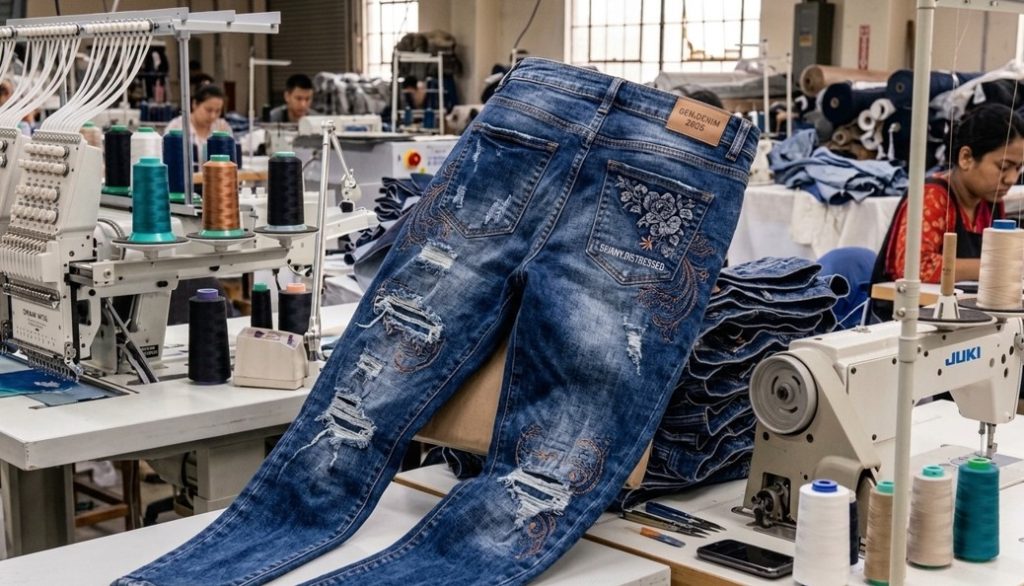
A ladies jeans manufacturer in Bangladesh usually handles a much wider mix of cuts and washes. Skinny fits, high-waisted styles, distressed finishes, and embroidery are all common. Seasonal trends shift fast in this category. Because of that, factories here often need quicker sampling turnaround. They also need more flexible production lines and closer design collaboration.
Private Label and OEM Producers
Many facilities also offer private-label manufacturing. Here, the buyer supplies its own designs and branding. The factory handles fabric sourcing, cutting, sewing, washing, and finishing. This model suits smaller or newer brands well. It offers flexibility without the volume commitments larger branded factories often require.
How Pricing Typically Works
Price varies a lot between factories. Volume is the biggest factor. Larger orders almost always bring the per-unit cost down. Fabric quality matters too. Heavier, premium denim costs more than basic stretch fabric.
Washing and finishing add cost as well. A simple raw wash is cheaper than multiple laser and enzyme treatments. Compliance also plays a role. Factories with more certifications often charge slightly more, but they reduce risk for the buyer.
A few quick pricing tips:
- Ask for a full cost breakdown — not just a single per-piece number
- Get quotes from more than one jeans manufacturer in Bangladesh before making a call
- Factor in shipping, duties, and sampling costs, not just the factory’s quoted price
- Treat quotes that look far cheaper than the market average with some suspicion
What to Look For Before Choosing a Jeans Manufacturer in Bangladesh
Picking the right partner isn’t just about who quotes the lowest price. A handful of factors tend to separate the reliable partners from the risky ones:
- Compliance certifications — BSCI, WRAP, OEKO-TEX, or LEED, depending on what your market actually requires
- Minimum order quantity (MOQ) — worth confirming upfront, especially if you’re a smaller brand
- Washing and finishing capability — enzyme wash, stone wash, laser fading, ozone treatment, and whatever else your designs call for
- Lead time reliability — ask for references or actual shipment history, not just a promised timeline
- Fabric sourcing transparency — some factories weave their own denim in-house, others import it
- Sample turnaround speed — a slow sampling process can quietly wreck a tight fashion-season deadline
Comparing Manufacturer Categories
Which manufacturer type fits best really comes down to your product line, order volume, and how fast your designs change season to season. Here’s a quick side-by-side comparison:
| Manufacturer Type | Typical Strength | Best Fit For |
| Branded production facility | Compliance, certifications, high-volume consistency | International fashion brands, large retail chains |
| Men’s-focused factory | Efficient, high-volume basic styles | Workwear brands, mass-market retailers |
| Ladies-focused factory | Design flexibility, fast style changes | Fashion-forward and seasonal brands |
| Private label/OEM factory | Custom branding, smaller batch flexibility | Startups and independent labels |
Sustainability and the Future of the Industry
Buyers now weigh environmental impact alongside price and lead time. This is reshaping how every jeans manufacturer in Bangladesh operates. More than 200 LEED-certified facilities now use laser fading, ozone treatment, and waterless finishing. That’s a big shift, since finishing has traditionally been one of the most water-heavy stages of denim production.
The industry’s growth over time also puts this shift in context:
| Period | Approximate Combined Export Figures |
| A decade ago | Denim contributed roughly $6 billion within total RMG exports |
| Recent single year | Over $2.6 billion in combined US + EU denim shipments |
| Current annual total | Exceeding $5 billion across all global export markets |
(These figures are approximate. They come from industry reporting by The Daily Star, Prothom Alo, and The Financial Express, citing OTEXA and Eurostat data. Verify against current official trade data before using them in business planning.)
A few trends are shaping what comes next:
- Digital sampling to cut down on physical shipping and speed up approvals
- AI-assisted inventory and demand planning to reduce overproduction
- Blockchain-based traceability so buyers can verify a garment’s supply chain
- Diversification into markets like Japan, Australia, and the Middle East
For buyers, this changes what “the best factory” even means. Price and lead time still matter. But sustainability and traceability now carry real weight too.
Frequently Asked Questions
Is Bangladesh a good country to source jeans from?
Pretty much, yes. A jeans manufacturer in Bangladesh puts you in business with the top denim supplier to both the US and EU — backed by decades of manufacturing experience and fabric mill capacity that keeps expanding.
How do I verify if a factory is legitimate?
Start with the compliance certifications — check they’re actually valid. Ask for audit reports, talk to existing clients if you can, and arrange a third-party inspection before any large order goes through.
What’s the difference between men’s and ladies’ denim lines?
Men’s factories usually run higher volumes of simpler, classic styles. Ladies’ lines move faster — more style changes, quicker sampling, less predictable demand.
Can small brands work with a large, export-focused factory?
Sometimes. A lot of bigger factories stick to high-volume orders only, but plenty run private-label divisions on the side. Sourcing agents can also bundle smaller orders together to hit minimums.
What certifications should I ask a factory for?
BSCI covers social compliance, OEKO-TEX handles chemical safety, WRAP deals with ethical manufacturing, and LEED signals environmental standards. Worth asking about all four.
How has the industry changed in the past decade?
Mill capacity has roughly quadrupled, monthly output now sits around 40 million yards of fabric, and the whole industry has moved away from basic, low-cost production toward something more design-capable and sustainability-driven.
Wrapping Up
None of this happened by accident. Decades of investment in mills, compliance, and know-how starting from a single $12,000 shipment back in 1984 — built the industry Bangladesh has today.
Whether you’re chasing a branded jeans manufacturer in Bangladesh, a men jeans manufacturer in Bangladesh for basics, or a ladies jeans manufacturer in Bangladesh that can turn styles around fast, the options span nearly every price point and scale. The real question isn’t who’s cheapest — it’s who actually fits what your brand needs.