


Introduction: What Will You Learn in This Guide?
T-shirts are probably one of the highly flexible items in the fashion world in all corners of the globe. They are appropriate for casual clothing, sportswear, corporate uniforms, promotional outfits, streetwear, and private-label clothing, being the favorite fabric for day-to-day use. Nonetheless, the process of mass production of a quality T-shirt requires more than just cutting and sewing the fabric. The type of material used, GSM, fitting, pattern, color, printing, finishing, quality control, packaging, and consistency of production all play a significant role in determining the outcome.
For retailers and fashion houses alike, finding the perfect T-shirt manufacturer is an essential part of creating a reliable supply chain for garments.
Being one of the biggest players in the field of garment manufacturing and exporting, Bangladesh is renowned for its production. The Bangladesh Garment Manufacturers and Exporters Association points out that Bangladesh has made around 38.70 billion USD in the export of ready-made garments in the period from 2025 to 2026, including T-shirts and other knitted garments that accounted for around 8.14 billion USD..
In this guide, you will learn:
- Why Bangladesh is an important T-shirt manufacturing destination
- How T-shirts are manufactured
- Which fabrics are commonly used
- How GSM affects T-shirt quality
- The importance of sampling and quality control
- Sustainable T-Shirt Manufacturer options
- What to look for when choosing a T-Shirt Manufacturer
- How Vero Style supports international apparel brands
- Questions to ask before placing a T-shirt production order
Why Is Bangladesh an Important T-Shirt Manufacturer Destination?
Bangladesh has established a strong apparel supply chain fully geared towards export, which meets the needs of numerous international fashion brands and buyers.
The knitwear sector plays a key role in the apparel sector in Bangladesh. As per the information given by BGMEA, the value of knitwear exported from Bangladesh for the financial year 2025-26 amounts to around US$20.62 Billion.
Knitwear T-Shirt Manufacturer constitute one of the main categories of exported apparel items from Bangladesh.
This type of setup allows international brands to have access to:
- Proficiency in apparel manufacturing
- Expertise in knitwear production
- Cloth and textile sourcing capabilities
- High-skilled manufacturing teams
- Product Development services
- Quality assurance
- International trading skills
- Sustainable materials
Thus, Bangladesh may be a country worth exploring for companies aiming at large-scale T-Shirt Manufacturer.
Bangladesh T-Shirt Industry: Key Statistics
The scale of Bangladesh’s apparel industry provides useful context for international buyers.
| Industry Indicator | FY2025–26 |
| Total RMG exports | US$38.70 billion |
| Knitwear exports | US$20.62 billion |
| Woven apparel exports | US$18.08 billion |
| T-shirts & knitted shirts | US$8.14 billion |
| Trousers | US$12.83 billion |
| Sweaters | US$5.16 billion |
| RMG share of total exports | 80.62% |
The figures are based on BGMEA’s export-performance data.
These numbers demonstrate that T-shirts are not a minor part of Bangladesh’s apparel industry. They represent one of the country’s largest individual apparel export categories.
What Makes a Good T-Shirt Manufacturer?
A T-Shirt Manufacturer partnership can be selected by considering a variety of factors, both technical and commercial in nature.
A dependable partnership must be knowledgeable in the areas of:
- The choice of fabric,
- GSM requirements,
- Patterning,
- Fit,
- Cutting,
- Sewing,
- Construction of the neck,
- Printing/embroidery,
- Dyeing,
- Washing processes,
- Quality control,
- Packing, and
- International shipping arrangements.
Moreover, the T-Shirt Manufacturer must also ensure uniformity while transferring from one prototype to thousands of items.
How Are T-Shirts Manufactured?
A typical T-Shirt Manufacturer manufacturing process involves several stages.
The basic process is:
Design → Fabric Selection → Sampling → Pattern Making → Cutting → Sewing → Printing/Embroidery → Finishing → Quality Control → Packing → Shipment
Each stage can affect the final quality of the garment.
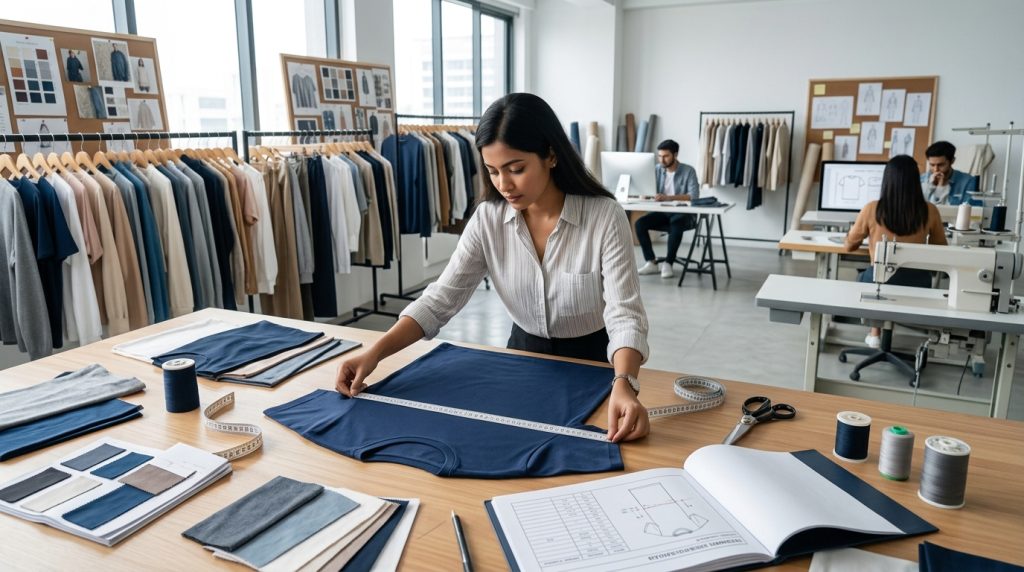
Step 1: Design and Product Development
The production process kicks off with product design.
It is at this point that the brand may come up with:
- Technical pack
- Sketch
- Sample garment
- Measurements
- Colour specifications
- Fabric specifications
- Brand specifications
- Packaging specifications
A product-development expert will help or find something that can transform the abovementioned points into a clear production specification.
This allows for any production problems to be resolved before actual production starts.
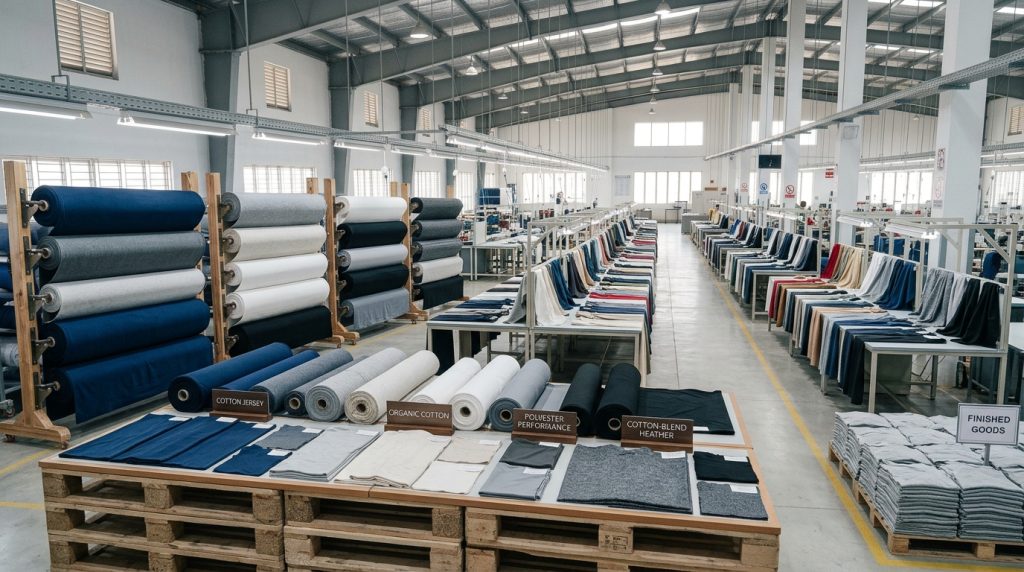
Step 2: Choosing the Right T-Shirt Fabric
Fabric is one of the most important factors affecting T-shirt quality.
Different fabrics provide different levels of:
- Comfort
- Breathability
- Stretch
- Durability
- Softness
- Weight
- Shape retention
Common T-Shirt Fabrics
| Fabric | Characteristics | Common Uses |
| 100% Cotton | Breathable and comfortable | Everyday T-shirts |
| Combed Cotton | Softer and smoother | Premium casualwear |
| Organic Cotton | Responsible fibre option | Sustainable collections |
| Cotton-Polyester Blend | Durability and easy care | Everyday and promotional wear |
| Polyester | Lightweight and moisture-managing | Sportswear |
| Cotton-Elastane | Stretch and comfort | Fitted T-shirts |
| Recycled Polyester | Recycled synthetic fibre | Sustainable activewear |
| Tencel/Lyocell | Soft and breathable | Premium lightweight apparel |
The right fabric depends on the product’s target market, price point, intended use, and design.
Understanding GSM in T-Shirt Manufacturing
One of the most important technical specifications for T-Shirt Manufacturer is GSM, or grams per square metre.
GSM indicates the approximate weight and density of the fabric.
For example:
| Approximate GSM | General T-Shirt Characteristics |
| 100–130 GSM | Very lightweight |
| 140–160 GSM | Lightweight |
| 160–180 GSM | Medium-weight |
| 180–220 GSM | Heavier, premium feel |
| 220+ GSM | Heavyweight/streetwear styles |
These ranges are general rather than universal.
The same GSM can feel different depending on the yarn, knitting structure, fibre composition, finishing, and construction.
For this reason, brands should approve an actual fabric swatch or sample rather than specifying GSM alone
Step 3: Pattern Development and Sampling
When the specification of the fabric is defined, patterning and sampling can start. Sampling gives insights to the brand to understand:
- Body length
- Chest width
- Shoulder width
- Length of sleeves
- Neck opening
- Armhole
- Overall fitting
- Fabric hand
- Color
- Stitchery
The sample should be approved before mass production.
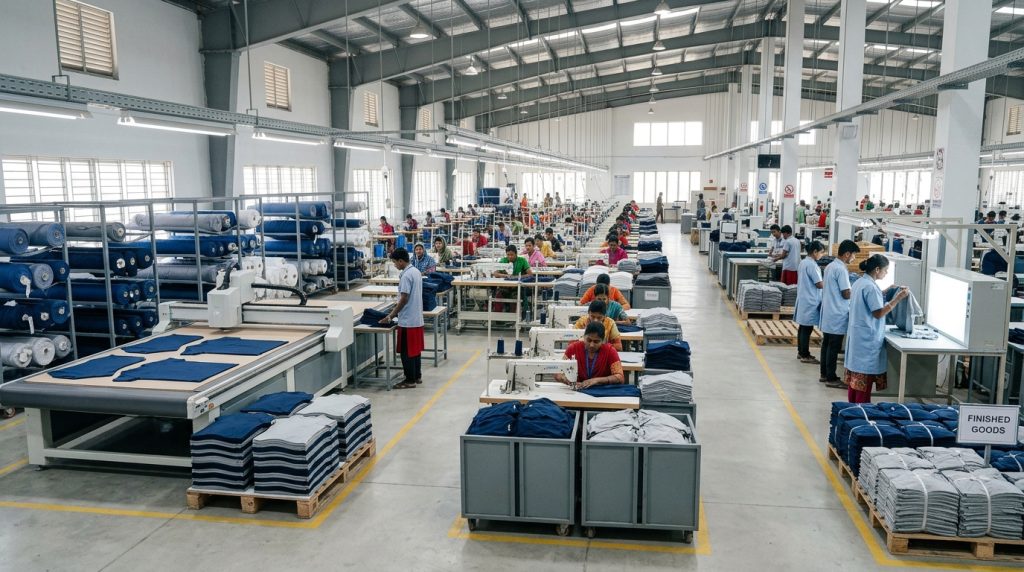
Step 4: Fabric Cutting
Once the fabric is approved, the fabric gets cut into shapes, in accordance with production plans.
Precise cutting plays an important role since unequally cut panels can lead to having:
- Non-uniform measurements
- Improper fitting
- Misaligned patterns
- Fabric wasted
In case of patterned or striped fabrics special attention should be paid to the matching of the matching patterns during the cutting process.
Step 5: Sewing and Construction
What comes next is sewing and assembling.
The cut parts must be sewn together and put together.
Important aspects of assembling are:
- Shoulder seams
- Side seams
- Sleeve connection
- Rib on neck
- Lower hem
- Hem on sleeves
- Labels
- Reinforcement points
Overall the shirt must have high-quality stitches.
Neck Construction Matters
The neck area of a T-shirt is one of its most distinctive features.
Some of the different types of necklines include:
- Crew neckline
- V-neckline
- Ribbed neckline
- Bound neckline
- Contrast neckline
- Mock neckline
When it comes to a neckline, it must be able to hold its shape constantly. If poorly constructed, the neckline can stretch out of shape, twist or become distorted with repeated wear.
Step 6: Printing and Embroidery
Various T-shirts can have designs made from graphical images, logos, or other branding.
The most common decoration methods are:
Screen Printing
Suitable for several large scale graphic applications.
Digital Printing
Suitable for detailed designs as well as smaller production runs of a product with lesser detail.
Heat Transfer
Used only for selected graphics and branding applications.
Embroidery
Achieves a durable yet textured branded effect.
Discharge Printing
Generates a less dense print on the appropriate fabric.
The choice of method is determined by:
- Artwork
- Fabric
- Color
- Quantity
- Desired product finish
- Budget
Step 7: Washing and Finishing
Finishing processes affect the final look and feel of a T-shirt.
Finishing processes can consist of:
- Softening
- Enzyme washing
- Garment washing
- Bio-polishing
- Silicone finishing
- Creation of special dye effects
The finishing stage has to be carefully controlled as it may affect the characteristics of the finished garment.
Step 8: Quality Control
Quality control has to be practiced during the whole period of production process.
It is essential to carry out such checks as:
- Defect in fabric
- Grams per square meter
- Color consistency
- Measurement
- Stitching
- Neck construction
- Printing
- Embroidery
- Shrinking
- Pilling
- Loose threads
- Finishing
- Packing
Only a professionally performed quality-control can minimize the possibility of defectiveness.
Common T-Shirt Defects to Avoid
- The list of common defects includes:
- Stitching problems
- Uneven edge seams
- Measurement mistakes
- Neck area distortion
- Fabric punctures
- Color differences
- Print deterioration
- Unsynchronized prints
- Too much shrinking
- Flying threads
- Low quality finishing
- Improper labeling
For manufacturers with high volume outputs, even a low percentage of defects may incur significant expenses.
This is the reason why quality assurance should be taken into account throughout the entire production process and not just during the final inspection.
Why Sampling Is Important Before Bulk Production
T-Shirt Manufacturer Manufacturing shouldn’t start just because the draft appears to be right.
Sampling provides the brand with a chance to check:
Fit
Does the item fit according to the intended size chart?
Fabric
Does the fabric have the required weight, softness and stretch?
Color
Does the fabric or garment correspond to the approved color sample?
Construction
Are the seams, hems and necklines built correctly?
Decoration
Is the printing and embroidery correctly placed?
Finishing
Does the item have the required look and feel?
Sustainable T-Shirt Manufacturing
Sustainability is growing in significance for brands along with consumers in the fashion industry.
T-shirt brands are getting more and more requests to think about:
- Fiber sourcing
- Water consumption
- Energy consumption
- Dyeing methods
- Chemical control
- Production waste
- Packaging
- Workers’ well-being
- Supply chain transparency
Vero Style expresses that it focuses itself on environmental production methods, ethically sourced materials, minimum waste, organic fibers, recycled materials, and non-harmful dyes.
Such a company also mentions energy-saving production, ethics of procurement, and waste minimization.
Sustainable Materials for T-Shirts
Depending on the product requirements, brands can consider several material options.
| Material | Potential Advantage |
| Organic Cotton | Avoids synthetic pesticides and fertilizers in cultivation |
| Recycled Cotton | Makes use of recycled cotton waste |
| BCI Cotton | Focuses on more responsible cotton production |
| Supima Cotton | Premium long-staple cotton |
| Tencel/Lyocell | Soft, breathable cellulosic fibre |
| Recycled Polyester | Uses recycled synthetic inputs |
| Hemp | Natural fibre requiring comparatively low agricultural inputs |
| Bamboo-based Fabric | Used in selected sustainable textile applications |
Vero Style specifically lists organic cotton, recycled cotton, BCI cotton, Supima cotton, Tencel, hemp, recycled polyester and bamboo fabric among its sustainable material options.
What Should You Look for in a T-Shirt Manufacturer?
Choosing the right T-Shirt Manufacturer involves more than comparing quotations.
1. Product Expertise
Look for experience with the type of T-shirt you want to produce.
For example:
- Basic T-shirts
- Premium T-shirts
- Oversized T-shirts
- Sports T-shirts
- Promotional T-shirts
- Organic cotton T-shirts
- Streetwear
- Private-label T-shirts
2. Fabric Sourcing
The manufacturer should be able to source fabrics that match your:
- Composition
- GSM
- Colour
- Hand feel
- Performance requirements
- Sustainability specifications
3. Sampling Capabilities
Confirm whether the partner can produce samples before bulk production.
4. Quality Assurance
Ask how quality is monitored during:
- Fabric sourcing
- Cutting
- Sewing
- Printing
- Finishing
- Final inspection
5. Production Capacity
The supplier should have sufficient capacity for your expected order volume without compromising quality.
6. International Experience
For international brands, experience with export requirements can simplify the production process.
7. Sustainability
If sustainability is important to your brand, ask for specific information about:
- Materials
- Certifications
- Factory practices
- Waste management
- Chemical management
- Energy use
Vero Style: Supporting International Apparel Brands
Vero Style Ltd. is a Bangladesh-based apparel buying house providing apparel sourcing, product development, manufacturing, quality assurance and global export solutions for international fashion brands through trusted factories.
The company states that it specializes in designing, sourcing and manufacturing high-quality apparel for the global fashion market. Its approach combines product development, fabric selection, production oversight and quality control.
For brands searching for a T-Shirt Manufacturer, this type of integrated sourcing model can help coordinate different stages of apparel production.
Vero Style’s broader apparel capabilities cover categories including:
- Casual wear
- Formal wear
- Home wear
- Outerwear
- Activewear
- Children’s wear
The company’s focus on product development and manufacturing coordination can be particularly useful for brands developing multiple products within the same collection.
Vero Style’s Approach to Sustainable T-Shirt Production
Sustainability is one of the areas highlighted by Vero Style.
The company states that it uses responsibly sourced materials and prioritizes:
- Organic fabrics
- Recycled materials
- Low-impact dyes
- Energy-efficient production
- Ethical sourcing
- Waste reduction
Its listed sustainable material options include organic cotton, recycled cotton, BCI cotton, Supima cotton, Tencel, hemp, recycled polyester and bamboo fabric.
For brands developing environmentally conscious T-shirts, material selection should be discussed at the beginning of product development rather than after the design has already been finalized.
T-Shirt Manufacturing Costs: What Influences the Price?
There is no single standard price for T-Shirt Manufacturer .
The final cost depends on several factors.
| Cost Factor | How It Can Affect Cost |
| Fabric composition | Premium or specialized fibres can increase cost |
| GSM | Heavier fabrics generally require more material |
| Yarn quality | Higher-quality yarns can increase material costs |
| Garment construction | Complex designs require additional production work |
| Printing | Number, size and technique affect cost |
| Embroidery | Adds material and production time |
| Dyeing/washing | Special treatments can increase processing costs |
| Quantity | Larger orders may improve production economics |
| Labels and trims | Custom components add cost |
| Packaging | Branded packaging increases the total cost |
| Sustainability requirements | Specialized or certified materials may cost more |
For this reason, fashion brands should compare overall value and production reliability, not simply the lowest quoted unit price.
Bangladesh T-Shirt Manufacturer vs. Other Sourcing Markets
When comparing potential manufacturing destinations, brands should evaluate the complete supply chain.
| Factor | What to Evaluate |
| Production capacity | Can the partner handle your order volume? |
| Knitwear expertise | Does the supplier specialize in T-shirts and related garments? |
| Fabric sourcing | Can required materials be sourced consistently? |
| Product development | Can samples and technical specifications be developed? |
| Quality control | What inspection procedures are used? |
| Sustainability | Can environmental and material requirements be met? |
| Cost | Does the product meet the target costing? |
| Lead time | Can the supplier meet seasonal deadlines? |
| Export experience | Can international orders be handled efficiently? |
| Communication | Is the supplier responsive and technically capable? |
The best T-Shirt Manufacturer is not necessarily the cheapest option.
The better choice is usually the partner that can consistently deliver the required combination of quality, cost, capacity, sustainability and reliability.
The Future of T-Shirt Manufacturing
The global T-Shirt Manufacturer market continues to evolve alongside broader changes in fashion and consumer expectations.
Brands are increasingly focusing on:
- Better fabric quality
- Sustainable materials
- Responsible production
- Supply-chain transparency
- Product traceability
- Efficient manufacturing
- Customization
- Premium basics
- Performance fabrics
Bangladesh’s existing knitwear infrastructure gives the country a strong foundation for serving these changing requirements.
With approximately US$20.62 billion in knitwear exports and US$8.14 billion in T-shirt and knitted-shirt exports in FY2025–26, the country’s knitwear sector remains a significant part of the global apparel supply chain.
For international fashion brands, the next generation of T-Shirt Manufacturer manufacturing partnerships will increasingly depend on combining technical expertise, quality, sustainability and reliable communication.
Conclusion: Choosing the Right T-Shirt Manufacturing Partner
Choosing a T-Shirt Manufacturer is not simply about finding a company that can produce garments at a low price.
A successful T-Shirt Manufacturer production partnership requires:
The right fabric + accurate fit + consistent construction + effective quality control + reliable sourcing + dependable delivery.
Bangladesh’s established knitwear and apparel industry makes it an important sourcing destination for international brands. The country’s T-shirt and knitted-shirt exports alone reached approximately US$8.14 billion in FY2025–26.
Vero Style Ltd. provides apparel sourcing, product development, manufacturing, quality assurance and global export solutions through trusted factories, while also emphasizing responsible materials and sustainable production practices.
For brands developing basic T-shirts, premium essentials, activewear, promotional apparel or private-label collections, selecting the right T-Shirt Manufacturer partner can make a significant difference to product quality and long-term supply-chain performance.
The right T-shirt manufacturer does more than produce a garment. It helps transform your design, specifications and brand requirements into a consistent product ready for the global market